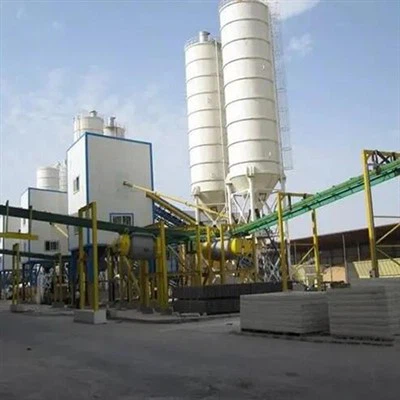
Hey there! I'm a supplier of wet batching plants, and today I want to chat about whether a wet batching plant can be used for self - compacting concrete production.
First off, let's understand what self - compacting concrete (SCC) is. SCC is a special type of concrete that can flow and fill formwork under its own weight, without the need for vibration. It has high fluidity, passing ability, and segregation resistance. This makes it ideal for complex structures, areas with dense reinforcement, and projects where vibration is difficult or not allowed.


Now, let's talk about wet batching plants. A wet batching plant is a facility where all the ingredients for concrete, such as cement, aggregates, water, and additives, are mixed together in a mixer to form a homogeneous concrete mixture before being transported to the construction site.
So, can a wet batching plant be used for SCC production? The answer is a big yes! And here's why.
Advantages of Using a Wet Batching Plant for SCC Production
1. Precise Mixing
One of the key requirements for SCC production is accurate proportioning of the ingredients. A wet batching plant is equipped with advanced weighing systems that can precisely measure the amount of cement, aggregates, water, and additives. This is crucial because even a small deviation in the mix proportions can significantly affect the properties of SCC. For example, if there's too much water, the concrete may become segregated, and if there's not enough superplasticizer (a key additive for SCC), the fluidity may be insufficient.
2. Homogeneous Mix
The mixers in wet batching plants are designed to produce a homogeneous mixture. Since SCC requires a uniform distribution of all ingredients to achieve its unique properties, a well - functioning mixer in a wet batching plant can ensure that the cement, aggregates, and additives are thoroughly mixed. This results in a consistent quality of SCC throughout the batch, which is essential for the structural integrity of the final concrete product.
3. Control over Additives
Additives play a vital role in SCC production. Superplasticizers are used to increase the fluidity of the concrete, while viscosity - modifying agents help to prevent segregation. A wet batching plant allows for precise control over the addition of these additives. The additives can be added at the right time and in the right quantity during the mixing process, ensuring that the SCC has the desired properties.
4. Flexibility
Wet batching plants offer a high degree of flexibility in terms of production volume. Whether you need a small batch of SCC for a minor project or a large volume for a major construction site, a wet batching plant can be adjusted accordingly. This is especially useful for contractors who work on different types of projects with varying concrete requirements.
Challenges and How to Overcome Them
Of course, using a wet batching plant for SCC production also comes with some challenges.
1. Mixing Time
SCC often requires a longer mixing time compared to traditional concrete. This is because the additives need more time to disperse evenly in the mixture. To overcome this, modern wet batching plants are designed with high - speed mixers that can reduce the mixing time without compromising the quality of the SCC. Additionally, the mixing process can be optimized by adjusting the order of ingredient addition.
2. Aggregate Quality
The quality of aggregates has a significant impact on the properties of SCC. Aggregates with a high content of fines or irregular shapes can affect the workability and stability of SCC. As a wet batching plant supplier, we recommend using high - quality aggregates and conducting regular quality checks. Some wet batching plants are also equipped with aggregate washing systems to remove any impurities from the aggregates.
3. Storage and Transportation
SCC has a limited working time, known as the slump - flow retention time. Once the SCC is produced in the wet batching plant, it needs to be transported to the construction site and placed in the formwork within a certain time frame. To address this, we can provide solutions such as using specialized transportation vehicles with agitators to keep the SCC in a workable state during transit.
Our Wet Batching Plant Solutions
We offer a range of wet batching plants that are suitable for SCC production. Our Fast Way Batch Plant is designed for high - speed and efficient production. It has a state - of - the - art control system that allows for precise proportioning of ingredients, making it ideal for SCC production.
If you need a more mobile solution, our Portable cement batch plant is a great option. It can be easily transported to different construction sites and set up quickly. This is especially useful for projects in remote locations or where the production needs to be moved frequently.
For large - scale projects, our New Ready Mix Plants are designed to produce high volumes of SCC with consistent quality. These plants are equipped with advanced mixers and weighing systems to ensure accurate and efficient production.
Conclusion
In conclusion, a wet batching plant can definitely be used for self - compacting concrete production. It offers many advantages in terms of precise mixing, homogeneous mix, control over additives, and flexibility. While there are some challenges, with the right equipment and proper management, these challenges can be overcome.
If you're interested in using a wet batching plant for SCC production or have any questions about our products, feel free to reach out to us. We're here to help you find the best solution for your concrete production needs. Let's start a conversation and see how we can work together to make your construction projects a success!
References
- Neville, A. M. (1995). Properties of Concrete. Pearson Education.
- ACI Committee 237. (2007). Guide to Self - Consolidating Concrete. American Concrete Institute.