


Fully Automatic Mortar Spraying Machine
Since 1998, Jinheng Machinery has been focusing on the design and production of the concrete mixing industry. Covering an area of 360000 square meters, it has two major production bases (Qingdao and Zhengzhou) and is divided into two business units (wet mixing and dry powder), with over 150 employees.Strict production processes are essential for improving equipment quality. JHT has processing equipment such as rust removal sandblasting machines, laser CNC machines, CNC laser cutting, boring machines, drilling machines, automatic welding robots, and electronic CNC rolling machines.Excellent equipment production lines and stable quality supporting parts are guaranteed. 20 years of experience in designing and manufacturing concrete mixing plants, long-term cooperation, and collaboration with BHS, SICOMA, WAM, ABB, IBM, SIEMENS Established a good friendship
Why Choose Us
Many devices
We have sandblasting machines, laser CNC machine tools, drilling machines, automatic welding robots, electronic CNC rolling machines and other machining equipment.
High-quality supporting suppliers
Our company has BHS, SICOMA, WAM, Siemens, Schneider, Toledo, Airtac, ABB and other suppliers.
Rich experience
We have 15 years of experience in OEM concrete mixing plants. Strict quality control and refined cost control have resulted in high-quality, low-priced concrete production lines.
Factory Strength
We have designed more than 20 concrete production lines, including new generation concrete mixing plants, mixing plants, and precast concrete mixing plants.

MINI RMC PLANT (capacity 10-90 cubic meters/hour) The mini rmc plant can produce 10 to 90 cubic meters of concrete per hour and provide a perfect concrete mixture, equipped with a bucket type aggregate supply system. The concrete mixing plant provides you with European quality and guarantees...

The Hydraulic splitting rod mainly consists of two parts: a high-level hydraulic pump station and a pull rod. The force output by the 140-180MP ultra-high pressure oil pump station acts on the pore wall of the split body, causing the rock to rupture in the predetermined direction under the...

Hydraulic Pile Breaking Machine
The hydraulic pile breaking machine provides pressure to multiple oil cylinders of the pile cutting machine through a power source, directly driving the drill pipe, compressing the pile body, and cutting off the pile head. The hydraulic pile breaking machine has the advantages of convenient......

Construction Waste Brick Production Line
The equipment of the Jinheng construction waste treatment production line utilizes waste materials such as construction waste, industrial waste residue, coal slag, coal rock, slag, fly ash, and non-metallic solid waste of building materials to produce new wall materials that meet the requirements through crushing, screening, stirring, and shaping.

Fully Automatic Mortar Spraying Machine
The fully automatic mortar spraying machine - N5S is a fast construction machinery that integrates mixing, pumping, and spray.

Ceramic Tile Adhesive Production Line
The ceramic tile adhesive production line is a technology that our company has combined with the production and installation of ceramic tile adhesive mixing equipment and self-leveling mortar mixing equipment in the past decade.

Fire Resistant Mortar Production Line
Fireproof mortar is a kind of thermal insulation mortar material made of inorganic thermal insulation materials such as non combustible vitrified beads and expanded Perlite with light bulk density and small thermal conductivity, and cement, redispersible rubber powder and polymer additives in a...

Insulation Mortar Production Line
The insulation mortar produced by the insulation mortar production line has better insulation and sound insulation effects compared to traditional ordinary mortar.

After years of experience, the new generation of special mortar production line, Wall putty production line and gypsum mortar production equipment developed by our company can adapt to the measurement and mixing of various raw materials, including vitrified beads, lignin fiber, building glue powder, polystyrene particles, expanded Perlite, heavy calcium and other special materials.
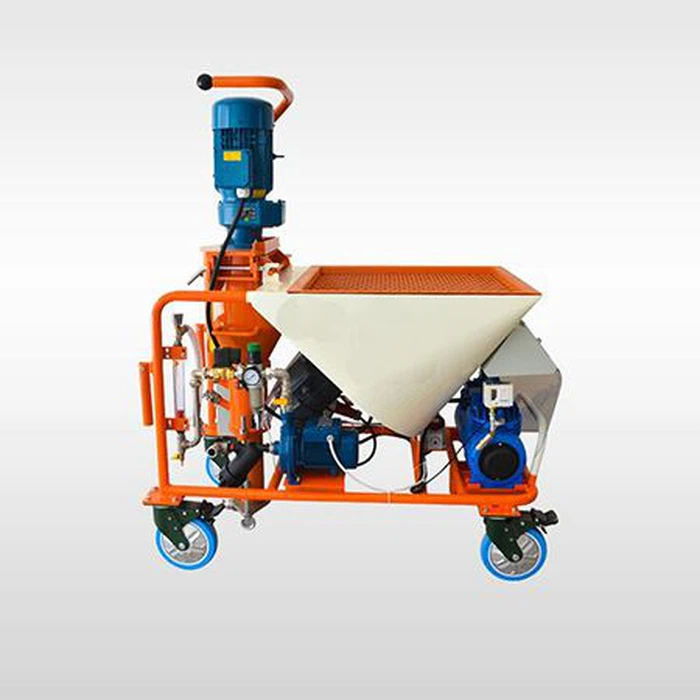
What is Fully Automatic Mortar Spraying Machine
The automatic mortar spray machine is a special tool that automatically covers the metal or non-metal surface with a protective layer or decorative layer to replace artificial labor with intelligence. The automatic mortar spray machine can be combined with the dust collector, leveling machine, paint baking machine and conveying work table lamp equipment to form an automatic production line, and the complexity of the machine can be determined according to the number of axes of the automatic glue spraying machine. Automatic mortar spray machines can be divided into glue spreading machines and arc paint spraying machines according to their uses, and can be divided into high-pressure airless glue spraying machines and two-component glue spraying machines according to their functions.
Benefits of Fully Automatic Mortar Spraying Machine
Increased efficiency
The fully automatic mortar spraying machine automation drastically reduces the time and effort required to apply mortar, resulting in significant time savings and faster project completion. Additionally, the uniform application of mortar ensures better bonding between bricks and stones, improving the overall structural integrity.
Reduced labor costs
The use of a fully automatic mortar spraying machine reduces the need for manual labor, which can be both costly and hard to find in today's competitive construction market. This results in lower labor costs and a more cost-effective construction process.
Improved quality
The even and consistent application of mortar by the machine ensures better bonding and a smoother finish, which translates to higher-quality structures with improved durability and longevity.
Reduced material waste
With precise control over the mortar application, the fully automatic mortar spraying machine minimizes wastage of materials, leading to cost savings and a more environmentally friendly construction process.
Enhanced safety
By eliminating the need for workers to manually handle heavy mortar loads and climb scaffolding, the use of a fully automatic mortar spraying machine reduces the risk of accidents and injuries on construction sites.
Application of Fully Automatic Mortar Spraying Machine
Masonry Construction
The primary application of the machine is in the construction of brick and stone walls, where they are used to apply the mortar that bonds the individual units together.
Plastering & Rendering
The machine can also be used to apply plaster or render to internal and external walls, providing a smooth, uniform finish that is both aesthetically pleasing and functional.
Grouting
In projects that require the filling of gaps or voids, such as in tunnel construction or soil stabilization, mortar spraying machines can be used to inject grout into the required areas.
Repair & Restoration
It can be used to apply repair mortar for the restoration of damaged or deteriorated structures, such as bridges, tunnels, and historic buildings.
Driving Mechanism
Linked to the cycloid reducer and positioned at one end of the machine, the driving device is powered by a motor. The motor is directly mounted on the reducer, aligned parallel to the rotor and stator axis.
Rotor Assembly
Crafted from special alloy materials and treated through high-temperature simmering and modulation, the rotor ensures durability. The stator, made from special rubber materials, enhances wear resistance, strength, and minimizes maintenance requirements.
Air Duct System
Driven by a 2.2KW motor, the air compressor generates high pressure air, regulated by safety and pressure-limiting valves. The pressurized air is then supplied to the nozzle for efficient mortar spraying.
Spraying System
Comprising wear-resistant slurry pipes for conveying and nozzles pressure-injected with polymer materials, this system ensures precise and effective mortar application. Mortar pipes, air pipes, and air valves are securely affixed to the nozzles.
Electrical Control System
Housed in the control box, this system incorporates an automatic leakage air switch, AC contactor, thermal relay, start, and stop buttons. It provides essential protection functions such as leakage, overcurrent, and short circuit safeguards.
Our mortar sprayer machine will make you more productive throughout your workday while preserving your quality standards. Pumping allows contractors to grow their business, achieving higher profits while saving extra time to complete more jobs. Additionally, these reliable, portable pumps are easy to move around a job site and fit into service elevators.The mortar spraying machine is mainly composed of a driving device, rotor assembly, air duct system, injection system, electrical control system, and other parts. The driving device is installed at one end of the machine by connecting the motor to the cycloid reducer, and the motor is directly installed on the reducer, parallel to the axis of the rotor and stator.
How to Maintain Fully Automatic Mortar Spraying Machine
●Electrical equipment: Including the inspection of motors, power supply, transmission lines, and electric control boxes, and each switch should be in the specified state.
●Lubricating oil: The hand oil pump is forced to refuel several times.
●Check the hopper for debris and slag.
●Inspection of shotcrete hoses, nozzles, and air ducts.
●Equipment air transportation inspection
a Jog the motor to check the rotation direction (the main motor is clockwise and the air compressor is counter-clockwise);
b Air compressor, air pressure, air volume, air gun adjustment;
c Check the situation of the instrument, especially whether the voltage meets the design requirements (380v), check the transmission line, wire diameter distance and joint connection, etc.
●The setting of air pressure and airflow is caused by the loosening of the air pressure switch parts during transportation, and the pressure spring should be readjusted.
Our Factory

Certifications

FAQ
Q: Can you spray mortar mix?
Q: What is a mortar machine?
Q: Can you add too much water to mortar mix?
Q: Is mortar stronger than thinset?
Q: Should I spray mortar with water?
Intermittently Spray the Mortar – Use a hose or spray bottle, depending on the size of your project to spray the mortar down every hour or so. It will help with step 1. Keep doing it for a few days after everything's finished. Make sure the water pressure isn't strong enough to move the mortar.
Q: What are the 3 main types of mortar?
Q: Why is my mortar turning to sand?
Q: What is the difference between Type N and Type S mortar?
Q: Why is my mortar not sticking to my brick?
Q: Why is my new mortar crumbling?
Q: How long does it take for mortar to reach full strength?
Brick mortar is made from Portland cement and is used for more structural and load bearing projects. It will reach 60% of its strength within the first 24 hours and will take up to 28 days to reach its full cure strength. There are 5 types of brick mortar, and all cure differently than each other.
Q: What is the shelf life of mortar mix?
SHELF LIFE: MORTAR MIX has a shelf life of 12 months when stored properly in a dry location, protected from moisture, out of direct sunlight, and in an undamaged package.If the mix is too dry or has too little water, it may not set properly. Cold weather can slow construction by affecting the set time and strength development of mortar and grout.
Q: How do you increase mortar adhesion?
Q: Why is my mortar turning to dust?
Q: What happens if too much sand in mortar?
Q: How does a mortar sprayer work?
Q: When would you use a spray machine?
Q: How wet should mortar be for pointing?
Q: How long will mortar last once mixed?
Q: How long does it take for mortar to fully cure?
Hot Tags: fully automatic mortar spraying machine, China fully automatic mortar spraying machine manufacturers, suppliers, factory, Sicoma Concrete Batching Plant, , ,
You Might Also Like


Send Inquiry