


Concrete Spraying Truck
Since 1998, Jinheng Machinery has been focusing on the design and production of the concrete mixing industry. Covering an area of 360000 square meters, it has two major production bases (Qingdao and Zhengzhou) and is divided into two business units (wet mixing and dry powder), with over 150 employees.Strict production processes are essential for improving equipment quality. JHT has processing equipment such as rust removal sandblasting machines, laser CNC machines, CNC laser cutting, boring machines, drilling machines, automatic welding robots, and electronic CNC rolling machines.Excellent equipment production lines and stable quality supporting parts are guaranteed. 20 years of experience in designing and manufacturing concrete mixing plants, long-term cooperation, and collaboration with BHS, SICOMA, WAM, ABB, IBM, SIEMENS Established a good friendship.
Why Choose Us
Many devices
We have sandblasting machines, laser CNC machine tools, drilling machines, automatic welding robots, electronic CNC rolling machines and other machining equipment.
High-quality supporting suppliers
Our company has BHS, SICOMA, WAM, Siemens, Schneider, Toledo, Airtac, ABB and other suppliers.
Rich experience
We have 15 years of experience in OEM concrete mixing plants. Strict quality control and refined cost control have resulted in high-quality, low-priced concrete production lines.
Factory Strength
We have designed more than 20 concrete production lines, including new generation concrete mixing plants, mixing plants, and precast concrete mixing plants.

The concrete spraying truck is a concrete wet spraying robot designed specifically for underground mines. It is available in both wide and narrow sizes depending on the size of the roadway, and is specially developed to solve the problem of wet spraying support in mines. This equipment is much...

The Hydraulic splitting rod mainly consists of two parts: a high-level hydraulic pump station and a pull rod. The force output by the 140-180MP ultra-high pressure oil pump station acts on the pore wall of the split body, causing the rock to rupture in the predetermined direction under the...

Hydraulic Pile Breaking Machine
The hydraulic pile breaking machine provides pressure to multiple oil cylinders of the pile cutting machine through a power source, directly driving the drill pipe, compressing the pile body, and cutting off the pile head. The hydraulic pile breaking machine has the advantages of convenient......

Construction Waste Brick Production Line
The equipment of the Jinheng construction waste treatment production line utilizes waste materials such as construction waste, industrial waste residue, coal slag, coal rock, slag, fly ash, and non-metallic solid waste of building materials to produce new wall materials that meet the requirements through crushing, screening, stirring, and shaping.

Fully Automatic Mortar Spraying Machine
The fully automatic mortar spraying machine - N5S is a fast construction machinery that integrates mixing, pumping, and spraying. It is widely used around the world, especially in developed countries such as Europe and America.

Ceramic Tile Adhesive Production Line
The ceramic tile adhesive production line is a technology that our company has combined with the production and installation of ceramic tile adhesive mixing equipment and self-leveling mortar mixing equipment in the past decade, summarizing the production process experience of ceramic tile adhesive and self-leveling mortar.

Fire Resistant Mortar Production Line
Fireproof mortar is a kind of thermal insulation mortar material made of inorganic thermal insulation materials such as non combustible vitrified beads and expanded Perlite with light bulk density and small thermal conductivity, and cement, redispersible rubber powder and polymer additives in a...

Insulation Mortar Production Line
The insulation mortar produced by the insulation mortar production line has better insulation and sound insulation effects compared to traditional ordinary mortar. Common types on the market are gypsum insulation mortar and cement insulation mortar, which are mostly used for building interior wall insulation.

After years of experience, the new generation of special mortar production line, Wall putty production line and gypsum mortar production equipment developed by our company can adapt to the measurement and mixing of various raw materials, including vitrified beads, lignin fiber, building glue powder, polystyrene particles, expanded Perlite, heavy calcium and other special materials.
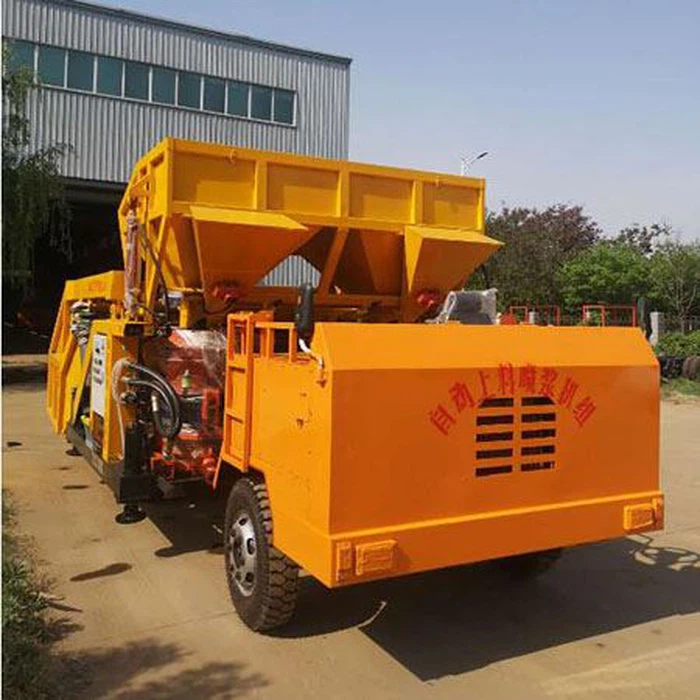
What is Concrete Spraying Truck
The concrete spraying truck is a concrete wet spraying robot designed specifically for underground mines. It is available in both wide and narrow sizes depending on the size of the roadway, and is specially developed to solve the problem of wet spraying support in mines. This equipment is much higher in production efficiency and rebound rate control than traditional operation methods. By using high-pressure close range spraying, the spraying quality can be improved to a new level, and is widely used in wet spraying support concrete spraying operations in underground mines or small and medium-sized underground projects.
Benefits of Concrete Spraying Truck
Improved efficiency and productivity
As mentioned earlier, one of the most significant advantages of using a concrete spraying truck is improved efficiency and productivity. With a mixer truck on site, you can save time and effort by eliminating the need for manual mixing methods. The truck can mix large amounts of concrete in a single load, which means you can get the job done quicker and move on to the next project faster. This can help you complete more projects in less time, increasing your overall productivity and profitability.
Consistent concrete quality
Another major advantage of using a concrete spraying truck is that it helps ensure consistent concrete quality. The mixer blades inside the drum rotate at a set speed, which ensures that all of the ingredients are evenly mixed. This means you'll get a consistent batch of concrete every time, which is essential when working on a large construction project where quality is vital. Consistent concrete quality can also help you avoid costly mistakes and rework, saving you time and money in the long run.
Reduced labor costs
Using a concrete spraying truck can also help reduce labor costs. By eliminating the need for manual mixing and transporting the concrete, your crew can focus on other tasks, allowing you to get more done with the same number of workers. This can lead to cost savings and increased profitability for your business. Additionally, the use of a concrete spraying truck can help reduce the risk of worker injuries, which can result in costly medical bills and lost productivity.
Enhanced jobsite safety
Concrete spraying truck also offer enhanced jobsite safety. With the concrete being mixed and transported in a single vehicle, there's less risk of accidents or injuries that can occur when manually transporting the material. Additionally, a concrete spraying truck helps limit the amount of dust and debris on the job site, which can lead to a safer and more comfortable work environment. The use of a mixer truck can also help reduce noise pollution, which can be a concern in residential areas.
Types of Concrete Spraying Truck
Dry shotcrete spray machine
After mixing cement and aggregate in proportion, they are evenly mixed and blown to the nozzle by compressed air, mixed with the pressure water from the pressure water tank and then sprayed out. This method is simple in construction and fast in speed.
Wet shotcrete spray machine
The concrete mixture that enters the spraying machine is already watered. Therefore, the dust content in the spraying is low and the rebound is also reduced, which is an ideal spraying method. However, wet materials are easy to condense in the material tank and pipeline.
Semi-wet shotcrete spray machine
Semi-wet type. Also known as wet type, the concrete mixture is a wet material with a moisture content of 5% to 8%. This material reduces dust when sprayed. Because it has less adhesion than wet materials and does not stick to the tank.
Truck mounted shotcrete machine
A truck-mounted shotcrete machine is a concrete conveying device that installs a moved device on a truck chassis. It has both the mobility of a truck chassis and the function of concrete shotcrete spray. The truck mounted shotcrete machine has a wide range of applications and can be widely used in large-scale construction projects and water conservancy projects. Good construction quality, ensuring the uniformity and consistency of concrete, and ensuring the accuracy and density of concrete pouring positioning.
Application of Concrete Spraying Truck
Construction of tunnels and underground structures
One of the most common applications of grout injection pumping stations is the construction of tunnels and underground structures.These grout injection pumping stations are used to inject cement slurry into the ground around the tunnel walls to prevent water penetration and stabilize the ground. This is crucial to ensure the safety and longevity of the tunnel structure.
Repair and maintenance of bridges, dams and other infrastructure projects
Grout injection pumping stations are also widely used in the repair and maintenance of bridges, dams and other infrastructure projects.By injecting grout into cracks and voids in concrete structures, these pump stations can effectively seal and reinforce damaged areas, extending the life of the infrastructure.
Geotechnical projects
Additionally, grout injection pumping stations are commonly used in geotechnical projects such as soil stabilization and foundation reinforcement. By injecting cement slurry into the ground, these grout injection pumping stations can increase the bearing capacity of the ground and prevent settlement or subsidence problems.
Concrete Spraying Truck Components
Compressed air system
The compressed air system is the core part of the concrete shotcrete spraying machine, which is mainly composed of a compressor, air tank, pressure gauge, etc.
Spraying system
The spraying system is the key part of the shotcrete spraying machine, which is mainly composed of gunite gun, shotcrete nozzle, shotcrete hose, rotating disk, guide plate, etc.
Pumping delivery system
The pumping delivery system is an important part of the concrete spraying machine, which is mainly composed of concrete hopper, delivery cylinder, concrete piston, wear plate etc.
Control system
The control system is an important part of the shotcrete spraying machine, which is mainly composed of electrical control box, buttons, switches, etc.
How to Choose Concrete Spraying Truck
Other than the two major types of asphalt plants, cement companies in Malaysia should also consider the working procedures of the manufacturing plants, including the cost and location of the plants. Both mobile asphalt and stationary asphalt plants are quite common. The production cost in mobile plants is typically far more than stationary plants.On the other hand, the location of the asphalt manufacturing plants also matters. Companies should also consider the local rules and regulations the area might have for particular production and manufacturing industry. Naturally, the manufacturing plant, like the asphalt plant, should be as near to your business as possible because it will dramatically cut down the transportation cost.
Cement companies in Malaysia should have an estimate of the production capacity they need. It can be decided based on the type and scale of the cement company. Once you are familiar with your production requirements, you will be able to determine the size of the asphalt plant that you will need for your business. After your requirements evaluation, you will have determined the overall type of the projects you have, the production capacity per hour, and whether you will need a continuous asphalt manufacturing process.
To ensure that you are able to enjoy the services and products of a well-managed asphalt plant, you have to consider all of the costs associated with such manufacturing process like transporting the material, maintaining the plants, and the regular repairs that you are likely to need when operating this heavy machinery.
Asphalt manufacturing plants can use a variety of processes and make themselves more efficient by implementing effective solutions and customised options. The kind of customisation heavily depends on cement companies in Malaysia. Hence, every company should find out about the most suitable machinery, methods, and overall working procedures for asphalt plants.
What are the Operation Procedures of Concrete Spraying Truck?
》Firstly, the truck discharges it's all concrete into a hopper i.e. on the back of the pump truck. If the concrete pump truck is based on electric motor or on diesel motor, both the operation comply different safety procedures.
》The hopper has a mesh grater that prevents any form of large rock or chunks from blocking the pump truck hoses. The hopper also has an auger that helps in churning the concrete keeping its liquid flowage.
》Once all the concrete gets transfer into the hopper, it get sucked into a valve system in small intervals. In case if you don't know what vault system is then here is the explanation, valve system is for controlling flow of concrete from the hopper to the pipe.
》As some of the concrete is being sucked into valve, the concrete aggregate simultaneously pushed through the concrete pipe until it reaches the end of the concrete hose and transferred where it needed.
》As long as the hopper stays full there are no blockages in concrete hoses, then the process of pumping goes quite smoothly.
》Pay attention to check the valves, if any leak slurry discovers, the work should be stopped to repair or replacement.
In the downtime cause of error, drain slurry valve should be open to decrease the pressure. Concrete pump pressure should not drop to zero.
》Maintenance work or climbing on the pipeline is strictly prohibited during machine process.
》After the transfer, discharge concrete aggregate from the pump entirely, and then turning off the power supply.
》The pump & hopper should be stopped immediately, manual cleaning of inner rotating pumps, always make sure to stand in a safe position.
》Washing pump shell, always make sure not to water electrical box. After cleaning, the operator is advised to leave all kinds of power switch blade.
How to Maintain Concrete Spraying Truck
Start with a documented process for cleaning your truck at the end of each day
To extend the life of any truck in your fleet, making sure that operators have a well-defined process for what is expected of them in terms of routine cleaning is imperative.For unloading and cleaning trucks each day, here are a couple of common checklist items for operating, including:Make sure your hydraulic system is operating properly.
Use a concrete dissolver to clean your truck periodically
Another cleaning trick that can help remove dried concrete from your trucks is to use a product like Back-Set.This product is biodegradable and is an acid-free solution to soften cement that can be rinsed off.This product you essentially apply and let sit for 15 minutes, and will begin to slowly soften. You can then take a brush to begin removing the excess concrete from your trucks. This stuff comes in a plastic tank with a foam sprayer and works best on concrete that isn't older. Check out this video to learn more.
Have a process for rinsing off your chute correctly on-site
One of the most important daily maintenance checks is making sure the chute is cleaned off prior to exiting a job site. It's also important to communicate to your team that this should be done prior to getting back on the highway to prevent potential safety hazards to drivers.You'll want to make sure you have a documented process for how to do this, including where exactly to rinse off on the job site your team is at.Many jurisdictions levy penalties for contaminating storm drains, so you will want to ensure drivers follow the proper procedures each and every time they rinse the chute.
Have a process for rinsing off your chute correctly on-site
One of the most important daily maintenance checks is making sure the chute is cleaned off prior to exiting a job site. It's also important to communicate to your team that this should be done prior to getting back on the highway to prevent potential safety hazards to drivers.You'll want to make sure you have a documented process for how to do this, including where exactly to rinse off on the job site your team is at.Many jurisdictions levy penalties for contaminating storm drains, so you will want to ensure drivers follow the proper procedures each and every time they rinse the chute.
Consider a washout system
With cutoffs at ground level controlling the hopper, collector, and drum nozzles, this ensures you clean the entire collector, drip ring, chute, and drum.So long as you maintain this type of system and dispose of washout properly, it's a good step to add to your process to ensure your trucks stay clean and maintained. If considering a new fleet of mixer trucks, this is one of those features that can make things a bit easier for drivers during post-trip inspections, and get your drivers back on the road a bit faster.
Our Factory

Certifications

FAQ
Q: What is the hazard of concrete pump truck?
Q: How long can concrete stay in a truck?
Q: How far can a concrete truck reach with a pump?
Q: What is the hazard of concrete truck?
Q: What are the 2 major problems in concrete pumping works?
Q: What are the safety requirements for pumping concrete?
Q: How much concrete can be pumped per hour?
Q: What is the time limit for concrete?
Q: Can you overmix concrete?
Q: How long is the chute on a concrete truck?
Q: How fast can a pump truck pump concrete?
How fast does a pump truck pump concrete? Some pumps can pump concrete at a rate of 30 to 100 cubic meters an hour. That's much faster than carting it around by hand!
Q: What is the difference between a cement truck and a concrete truck?
Q: What is the minimum slump for concrete pump?
The workability of pumped concrete, in general, has an average slump of between 50 mm and 100 mm. A concrete of less than 50 mm slump is impractical for pumping, and slump above 125 mm should be avoided. In mixtures with a high slump, the aggregate will segregate from the mortar and paste and cause choking.
Q: What are the precautions taken in pumping the concrete?
Q: What safety precautions should be taken while working near a concrete pump truck?
Q: What PPE is required for concrete pumping?
Q: What is the maximum discharge time for truck mixed concrete with a set retarding admixture?
Q: What is the rule 41 and 42 for concrete?
Q: How long can concrete mix in a truck?
Q: What is the mixing speed of a concrete truck?
Hot Tags: concrete spraying truck, China concrete spraying truck manufacturers, suppliers, factory, , , ,
You Might Also Like


Send Inquiry