


1500 Ton Cement Production Line Per Day
Jinheng Machinery has successively completed the construction of more than 30 cement production lines and exported them to more than 20 countries around the world. It has sold products to customers in more than 10 countries along the "the Belt and Road" and provided one-stop solutions such as engineering design, civil construction, equipment integration, installation and commissioning, and production services.
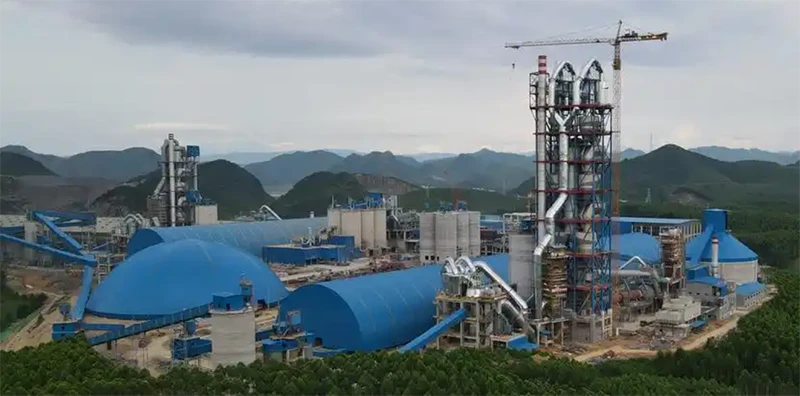
process parameters
(1) Clinker production: ≥ 1500t/d;
(2) Heat consumption: ≤ 840kcal/kg clinker
(3) Electricity consumption: ≤ 110kwh/t cement
(4) Water consumption: maximum 1020m3/d
production method
Cement production mainly uses limestone and clay as raw materials, which are crushed, proportioned, and ground into raw materials through ball mills. Then, they are sent into a cement rotary kiln to calcine the mature materials. Add an appropriate amount of gypsum to the clinker, mix it with some mixed materials or additives, grind it into cement through cement grinding, and then transport it out of the factory using a packaging machine or bulk loader. The dry cement production process is commonly used in cement production equipment. The method of simultaneously drying and grinding raw materials into raw material powder, and sending it into a drying rotary kiln to calcine mature materials. The main advantage of dry production is low heat consumption.
host device
Process Description
(1) Limestone and sandstone crushing
Limestone and sandstone are crushed by their respective crushers and discharged through belt conveyors.
(2) Limestone pre homogenization treatment
Crushed limestone is piled up in a pre homogenization greenhouse. Pre homogenized limestone is recovered by a reclaimer and transported to the raw material abrasive bin by a belt conveyor.
(3) Sandstone storage and processing
Sandstone is crushed and stored in sandstone storage tanks. It is extracted from the storage bin by a belt extractor and transported to the raw material mill feed bin by a belt conveyor.
(4) Clay storage and processing
During the dry season, clay is transported by truck from the quarry to the clay storage bin and stacked by bulldozers or loaders. Clay is taken out from the storage bin by a loader, fed into the hopper, and transported to the raw material grinding bin by a belt conveyor.
(5) Grinding and transportation of raw materials
The raw materials are extracted from their respective silos through belt scales (clay plates) and transported to the raw material grinding system through belt conveyors. The raw material mill is a closed-loop gas sweep ball mill.
The hot air discharged from the preheater serves as the heat source for drying the raw material mill. When the hot gas in the kiln or preheater is insufficient, there is also a backup oil furnace to supply hot gas.
(6) Raw material homogenization enters the preheater
In the mixed silo, the raw materials are homogenized to achieve the desired level of product consistency. The homogenized raw materials are transported from the batching bin to the preheater through the kiln feeding system, which consists of a liquid level tank, flow valve, weight gauge, air slide valve, and bucket elevator.
(7) Burning of clinker
The raw materials are heated and pre decomposed in a five stage preheater/calcination furnace, and enter the kiln during the 90-95% decarbonization period. The hot clinker in the kiln is cooled in the clinker cooler. The cold clinker from the cooler is transported by a bucket conveyor to two clinker silos.
Part of the exhaust gas from the clinker cooler is used as a heat source for the coal mill. Part of the exhaust gas emitted from the grate cooler is used as secondary air to enter the kiln, while another part is used as tertiary air to enter the calcination furnace. The remaining exhaust gas is discharged into the atmosphere after bag dust removal by the air-cooled heat exchanger.
(8) Kiln/Raw Material Grinding Waste Gas Treatment
Part of the exhaust gas from the kiln preheater outlet is used as the heat source for the raw material grinding system. The remaining part, together with the raw material grinding waste gas, is discharged into the atmosphere after being dedusted by a bag filter with an air-to-air heat exchanger. The dust collected in the bag room is sent to the homogenization warehouse or clinker warehouse.
(9) Coal slurry preparation and feeding system
After arriving at the factory, the peat is piled up in a covered storage area using bulldozers or loaders. Mud coal is transported from the storage bin to the extraction funnel by a loader. The weighing feeder unloads the material onto the belt conveyor, which transports the peat to the feed bin of the mill.
(10) Storage and processing of clinker
The clinker is extracted from the storage bin by a belt extractor and transported to the cement abrasive bin by a belt conveyor. The silo has two extraction points, one for each cement mill.
(11) Storage, crushing, and processing of gypsum and volcanic ash
After arriving at the factory, crush, dry and stack the volcanic ash in the warehouse; Gypsum will also be crushed and stored. Gypsum and volcanic ash are both supplied from the warehouse by loaders and transported to their respective cement mill silos by belt conveyors.
(12) Cement grinding
Clinker, volcanic ash, and gypsum are mixed using a belt scale according to the set values, and then the mixture is sent to a closed-loop cement mill using a belt conveyor. The ground product is transported to the cement silo through a bucket elevator. The gas outside the mill is discharged into the atmosphere after being dedusted by a bag filter.
(13) Cement storage and transportation
Cement is stored in four equally sized silos. The silo has a conical bottom (not a flat bottom) and is equipped with an air cushion to ensure consistent extraction rates.
Cement is transported from the silo to the packaging plant through pneumatic slides and bucket elevators. Provide a bulk loading station equipped with telescopic chutes and dust collection devices; It can only be fed from one silo.
The packaging device consists of two rotating 8-nozzle packaging systems, each with a capacity of 100t/h. Bagged cement is loaded onto trucks or transported to product warehouses via belt conveyors. Each packer system can feed from two cement silos in an alternating manner.
(14) Compressed air station
Compressed air is mainly used for bag filters, gas control valves, preheater groups, and pneumatic instruments. The total compressed air demand is 40m3/min, with a pressure of 0.5~0.7MPa. The site consists of 4 air compressors and supporting drying/filtering equipment, with 3 in use and 1 standby. The capacity of each compressor unit is 15m3/min, and the exhaust pressure is 0.75mpa. Compressed air specifications: temperature<40 ° C, dust diameter<1 μ m, oil 0.01ppm, pressure 2-10 ° C.
(15) Cooling water system
The cooling water comes from the water intake of the existing water system in the factory. The cooling water system is a closed-loop system used to reduce consumption, consisting of circulating pumps, cooling towers, and water treatment.
Hot Tags: 1500 ton cement production line per day, China 1500 ton cement production line per day manufacturers, suppliers, factory, crusher maintenance skills
You Might Also Like


Send Inquiry